
The Top Paid AI Tools Map — June 2026

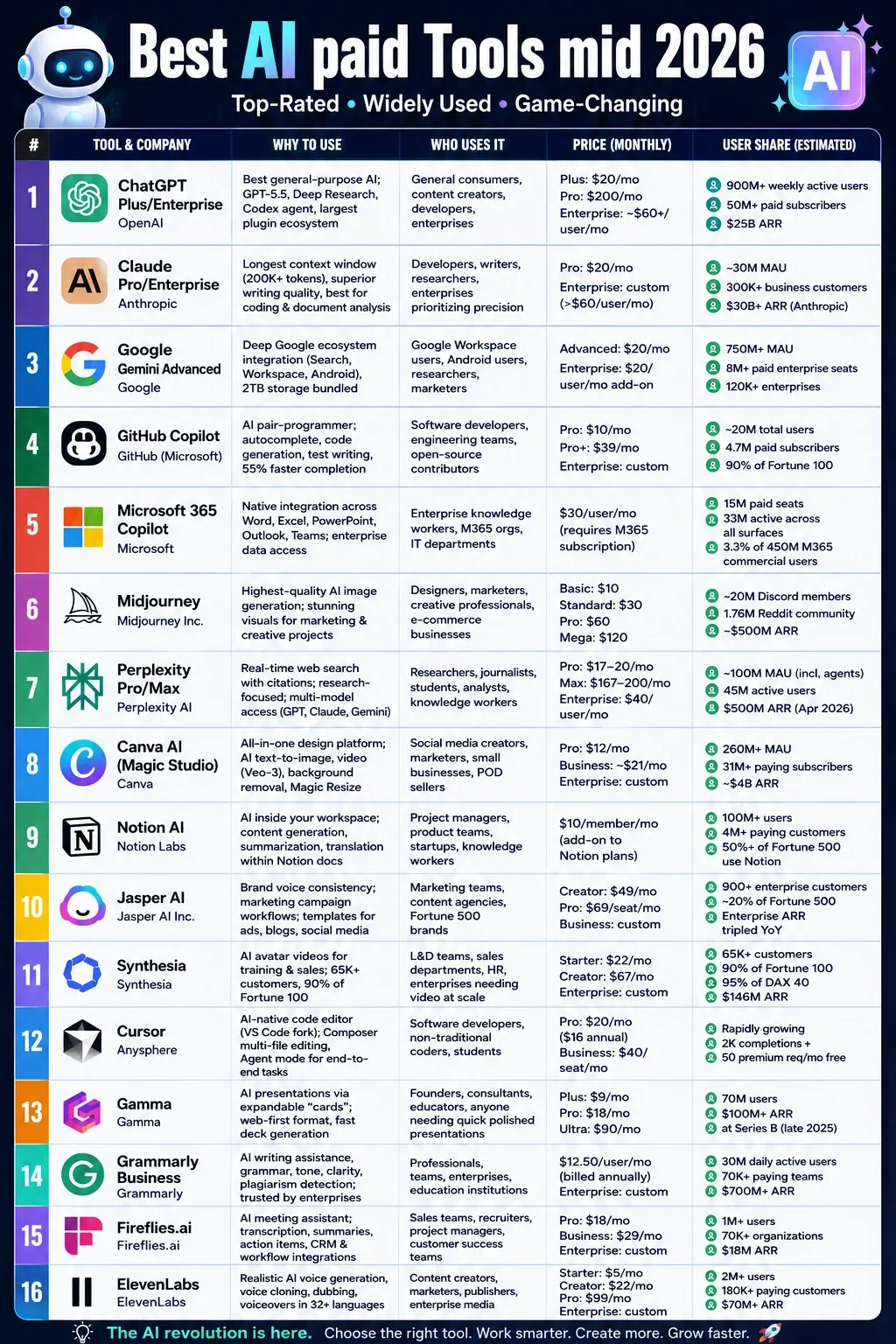
The AI software market has matured significantly. Consumer Pro tiers have stayed flat at ~$20/month even as model capabilities surged — effectively a price cut. Enterprise tiers are diverging: usage-based pricing on AI agent platforms is rising, while flat-rate enterprise seats have stabilized around $30–60/user/month. The biggest 2026 shift is that "free" tiers are now genuinely capable.
Top Paid AI Tools Map
| Tool Name | Company | Why to Use | Who Uses It | Price (Monthly) | User Share (Estimated) |
|---|---|---|---|---|---|
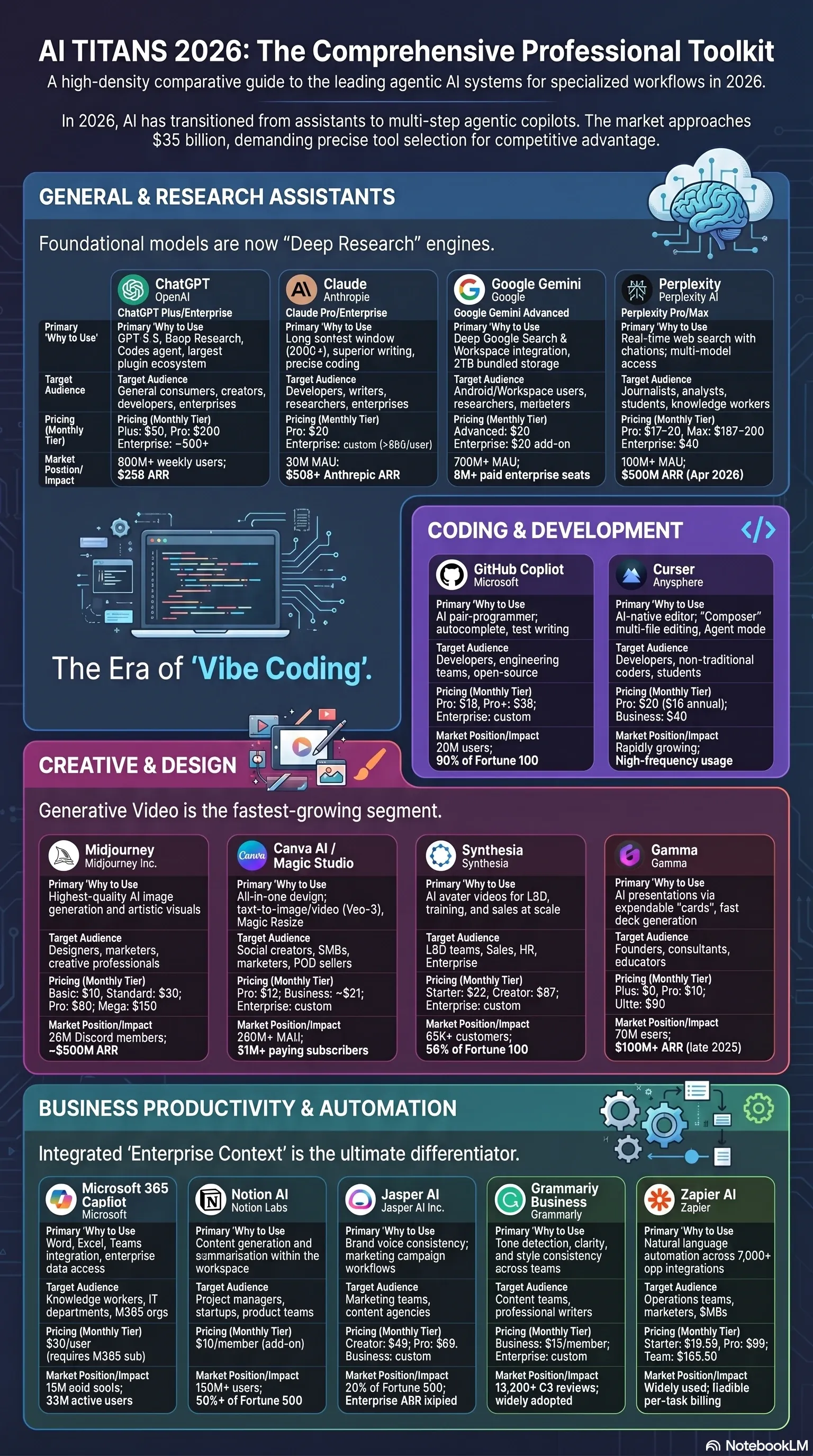
| ChatGPT Plus/Enterprise | OpenAI | Best general-purpose AI; GPT-5.5, Deep Research, Codex agent, largest plugin ecosystem | General consumers, content creators, developers, enterprises | Plus: $20/mo; Pro: $200/mo; Enterprise: ~$60+/user/mo | 900M+ weekly active users; 50M+ paid subscribers; $25B ARR |
| Claude Pro/Enterprise | Anthropic | Longest context window (200K+ tokens), superior writing quality, best for coding and document analysis | Developers, writers, researchers, enterprises prioritizing precision | Pro: $20/mo; Enterprise: custom (>$60/user/mo) | ~30M MAU; 300K+ business customers; $30B+ ARR (Anthropic) |
| Google Gemini Advanced | Deep Google ecosystem integration (Search, Workspace, Android), 2TB storage bundled | Google Workspace users, Android users, researchers, marketers | Advanced: $20/mo; Enterprise: $20/user/mo add-on | 750M+ MAU; 8M+ paid enterprise seats; 120K+ enterprises | |
| GitHub Copilot | GitHub (Microsoft) | AI pair-programmer; autocomplete, code generation, test writing, 55% faster task completion | Software developers, engineering teams, open-source contributors | Pro: $10/mo; Pro+: $39/mo; Enterprise: custom | ~20M total users; 4.7M paid subscribers; 90% of Fortune 100 |
| Microsoft 365 Copilot | Microsoft | Native integration across Word, Excel, PowerPoint, Outlook, Teams; enterprise data access | Enterprise knowledge workers, Microsoft 365 organizations, IT departments | $30/user/mo (requires M365 subscription) | 15M paid seats; 33M active across all surfaces; 3.3% of 450M M365 commercial users |
| Midjourney | Midjourney Inc. | Highest-quality AI image generation; stunning visuals for marketing and creative projects | Designers, marketers, creative professionals, e-commerce businesses | Basic: $10; Standard: $30; Pro: $60; Mega: $120 | ~20M Discord members; 1.76M Reddit community; ~$500M ARR |
| Perplexity Pro/Max | Perplexity AI | Real-time web search with citations; research-focused; multi-model access (GPT, Claude, Gemini) | Researchers, journalists, students, analysts, knowledge workers | Pro: $17–20/mo; Max: $167–200/mo; Enterprise: $40/user/mo | ~100M MAU (incl. agents); 45M active users; $500M ARR (Apr 2026) |
| Canva AI (Magic Studio) | Canva | All-in-one design platform; AI text-to-image, video (Veo-3), background removal, Magic Resize | Social media creators, marketers, small businesses, POD sellers | Pro: $12/mo; Business: ~$21/mo; Enterprise: custom | 260M+ MAU; 31M+ paying subscribers; ~$4B ARR |
| Notion AI | Notion Labs | AI inside your workspace; content generation, summarization, translation within Notion docs | Project managers, product teams, startups, knowledge workers | $10/member/mo (add-on to Notion plans) | 100M+ users; 4M+ paying customers; 50%+ of Fortune 500 use Notion |
| Jasper AI | Jasper AI Inc. | Brand voice consistency; marketing campaign workflows; templates for ads, blogs, social media | Marketing teams, content agencies, Fortune 500 brands | Creator: $49/mo; Pro: $69/seat/mo; Business: custom | 900+ enterprise customers; ~20% of Fortune 500; enterprise ARR tripled YoY |
| Synthesia | Synthesia | AI avatar videos for training and sales; 65K+ customers, 90% of Fortune 100 | L&D teams, sales departments, HR, enterprises needing video at scale | Starter: $22/mo; Creator: $67/mo; Enterprise: custom | 65K+ customers; 90% of Fortune 100; 95% of DAX 40; $146M ARR |
| Cursor | Anysphere | AI-native code editor (VS Code fork); Composer multi-file editing, Agent mode for end-to-end tasks | Software developers, non-traditional coders, students | Pro: $20/mo ($16 annual); Business: $40/seat/mo | Rapidly growing; 2K completions + 50 premium req/mo free |
| Gamma | Gamma | AI presentations via expandable "cards"; web-first format, fast deck generation | Founders, consultants, educators, anyone needing quick polished presentations | Plus: $9/mo; Pro: $18/mo; Ultra: $90/mo | 70M users; $100M+ ARR at Series B (late 2025) |
| Grammarly Business | Grammarly | Tone detection, clarity improvements, style consistency across teams; communication quality | Content teams, professional writers, organizations prioritizing communication quality | Business: $15/member/mo (min 3); Enterprise: custom | 13,330+ G2 reviews; widely adopted across content teams |
| Zapier AI | Zapier | Build automations via natural language; workflow suggestions across 7,000+ app integrations | Operations teams, SMBs, marketers automating cross-app workflows | Starter: $19.99/mo; Professional: $69/mo; Team: $103.50/mo | Widely used; per-task billing; $448–820/mo at 50K operations scale |
Field Definitions: Why Each Field Matters
| Field | Why |
|---|---|
| Name | Identification — quickly recognize the tool and associate it with its brand/company |
| Category | Organization — group tools by function (chatbot, image gen, code, automation, design, etc.) for easier comparison |
| Description | Quick understanding — one-sentence summary of what the tool does and its primary value proposition |
| Pricing | Buying decision — essential for budget planning, ROI calculation, and procurement approvals |
| API Available | Technical evaluation — determines if the tool can be integrated into existing workflows, products, or custom pipelines |
| Team Features | Business evaluation — assesses admin controls, collaboration, security, and scalability for team/enterprise adoption |
| Strengths | Comparison — highlights unique advantages to differentiate from competitors in the same category |
| Weaknesses | Trust — surfaces limitations, risks, or gaps that could block adoption or cause churn |
| Best Use Cases | Matching — ensures the tool aligns with specific job-to-be-done scenarios and user personas |
| Alternatives | Retention — provides fallback options if pricing changes, features shift, or support degrades |
| Last Updated | Credibility — signals how current the data is; AI pricing and features change rapidly, so freshness matters |
Extended Evaluation Fields
| Field | Value |
|---|---|
| Cost-per-user comparison | Procurement — enables apples-to-apples cost analysis across vendors; critical for multi-seat enterprise deals and budget justification |
| Security compliance | Enterprise — determines if the tool meets SOC 2, GDPR, HIPAA, or FedRAMP requirements; often a hard gate for regulated industries |
| Funding status | Market intelligence — signals financial stability, runway, and strategic direction; helps assess vendor longevity and acquisition risk |
| Usage estimates | Competitive analysis — reveals market penetration, growth trajectory, and user engagement; useful for benchmarking and trend forecasting |
| Changelog history | Tracking — documents feature additions, deprecations, and pricing changes over time; essential for contract renewal negotiations and roadmap alignment |
| Feature scorecards | Evaluation — provides structured, criteria-based assessment (e.g., G2/TrustRadius scores) to reduce subjective bias in tool selection |
Key Market Trends (June 2026)
- Consumer Pro tiers are flat — $20/month has become the standard for individual AI subscriptions, even as models have grown dramatically more capable.
- Enterprise pricing is diverging — Flat-rate seats ($30–60/user/mo) compete with usage-based agent pricing that can scale unpredictably.
- Free tiers are now genuinely capable — Microsoft Copilot in Windows 11 and Google Gemini in Workspace cover most consumer use cases at $0.
- Dual-vendor strategies are the norm — 79% of OpenAI users also pay for Anthropic. Enterprises run ChatGPT and Claude side by side.
- Agentic AI is the new monetization layer — Perplexity's Computer agent drove a 50% revenue jump in one month. Tools are pivoting from "chat" to "autonomous task completion."
- Specialized tools command premiums — Jasper ($49+/mo), Synthesia ($22+/mo), and Midjourney ($10–120/mo) charge more than generalists because they solve narrow problems exceptionally well.
Data compiled from vendor disclosures, earnings calls, Similarweb/Apptopia traffic data, Sacra estimates, and industry reports.