
GPT-6 Astra Review & Performance Tests

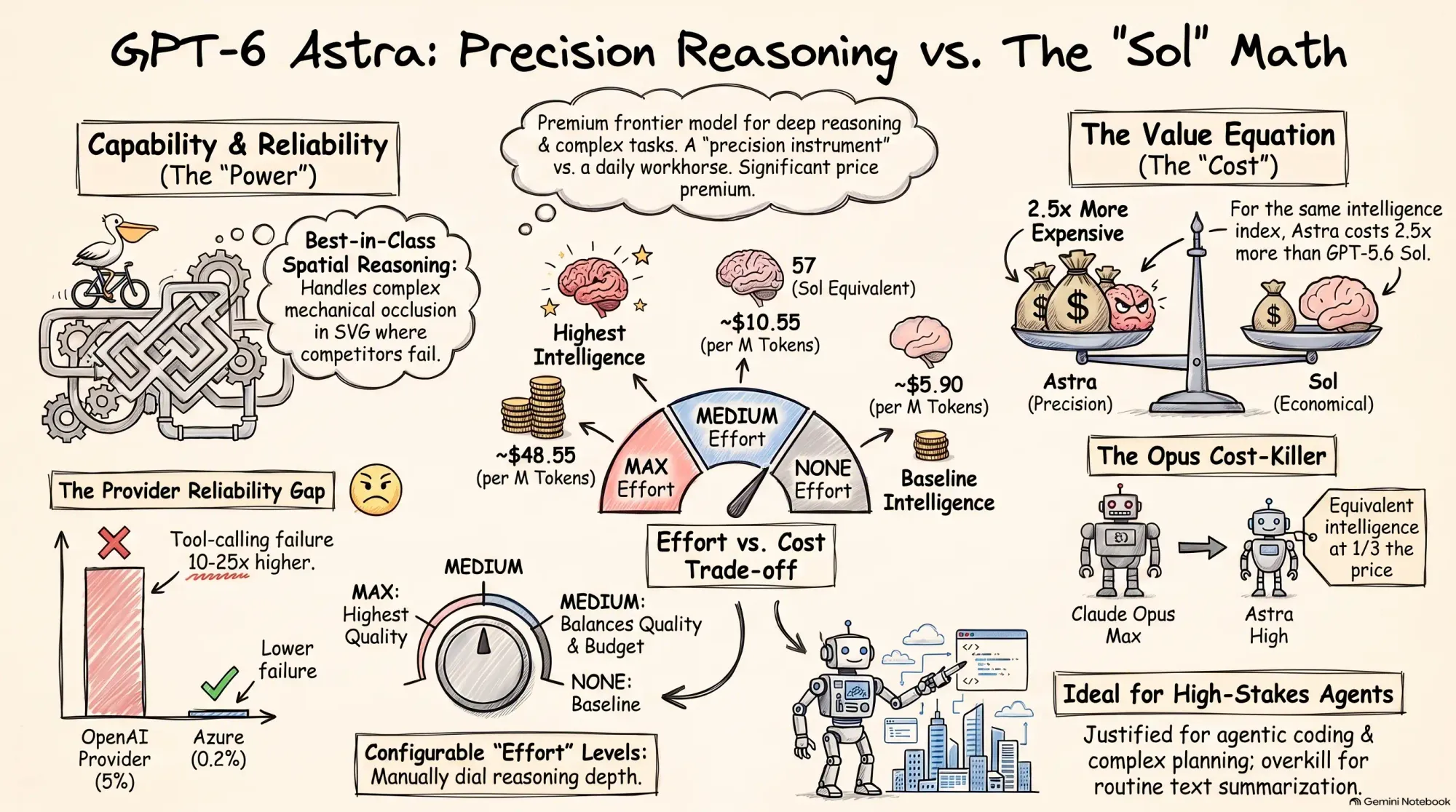
Summary: GPT-6 Astra is OpenAI's most capable reasoning model, and it performs like it — when you can afford to run it. At $10/$50 per million tokens, it's positioned as a premium frontier model that undercuts Anthropic's Opus on price while delivering comparable intelligence scores. The catch? It's roughly 2.5× more expensive than OpenAI's own GPT-5.6 Sol for equivalent benchmark performance, and its tool-calling reliability varies sharply depending on which provider hosts it. If your workload genuinely needs the absolute best reasoning and SVG/code generation quality, Astra is defensible. For most production use cases, the math is harder to justify.
| Dimension | Assessment |
|---|---|
| Raw capability | ★★★★★ — Best-in-class reasoning and code generation |
| Speed | ★★★★☆ — 55 tok/s peak, but feels faster than Sol in practice |
| Pricing | ★★☆☆☆ — $10/$50 per M tokens; 2.5× Sol at equivalent intelligence |
| Reliability | ★★★☆☆ — 98.77% availability; 5% tool-call failure rate on OpenAI provider |
| Value | ★★★☆☆ — Excellent for edge cases, poor as a daily workhorse |
What Is GPT-6 Astra?
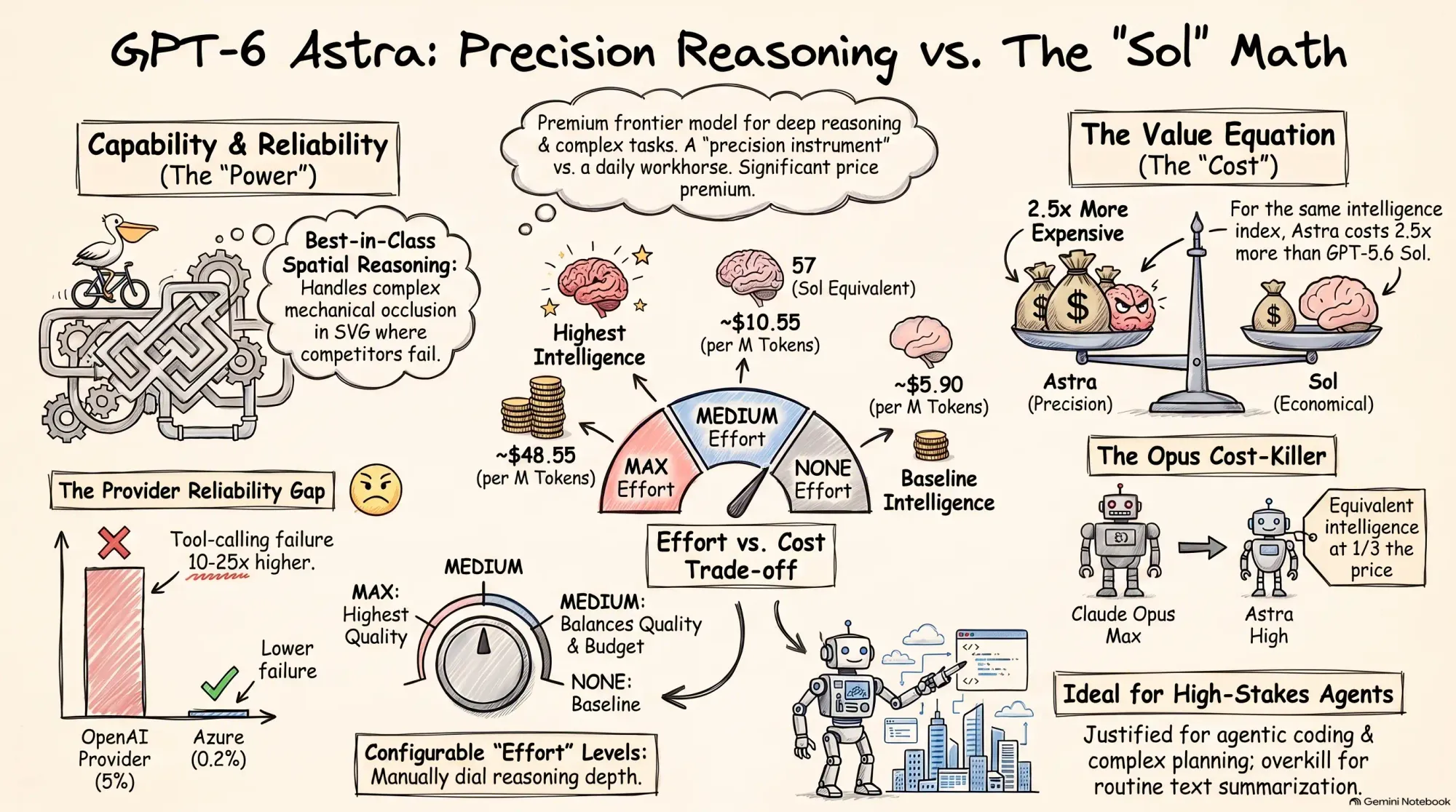
GPT-6 Astra is OpenAI's flagship reasoning model, accessible through OpenRouter and directly via OpenAI's API. Unlike standard completion models, Astra exposes configurable "effort" levels — max, xhigh, high, medium, low, and none — which control how much compute the model spends reasoning before responding. This makes it less of a drop-in replacement and more of a precision instrument: you dial the effort up when the task demands it, and down when you're burning budget on simple prompts.
On OpenRouter, Astra is hosted by multiple providers (OpenAI, Azure, and others), with routing modes that let you optimize for price, speed, or tool-calling accuracy. The model has quickly become a favorite for agentic workloads — it currently powers the Hermes Agent and Codex apps on OpenRouter, which together account for over 10 billion tokens of traffic.
Performance & Benchmarks
Infrastructure Metrics
OpenRouter continuously monitors provider health. Over the last 72 hours, Astra maintained 100% uptime at the infrastructure level, with 98.77% actual availability once routing failures are factored in.
| Metric | Best Provider (P50) | Notes |
|---|---|---|
| Throughput | 55 tok/s | Peak across providers; typical is lower |
| Latency | 2.89s | Total round-trip |
| TTFT | Varies by provider | Best case ~2.89s, worst ~10.31s |
| Uptime (3d) | 100% | Infrastructure level |
| Availability (3d) | 98.77% | After routing recovery |
The Pelican Test: Real-World SVG Generation
The most revealing benchmark for Astra isn't a leaderboard — it's Simon Willison's "pelican riding a bicycle" SVG test, which has become an informal industry standard for evaluating spatial reasoning, occlusion handling, and artistic coherence.
In head-to-head testing across effort levels, Astra demonstrated something no other model managed: correct occlusion of the crank and leg at max and medium effort levels. Where competitors typically render the pedal passing through the leg or ignore mechanical logic entirely, Astra's max-output pelican actually looked like it was made by a professional artist — complete with a yellow sun in the top-right corner, a green bike, and anatomically plausible leg positioning.
However, the community also noticed a quirk: Astra's outputs are remarkably consistent across runs. Same yellow sun. Same green bike. Same leg style. As one HN commenter noted, "Astra is the only model that correctly depicts occlusion... although interestingly, at max and medium levels (not in between)." Another observed that "Astra pelican looks amazing... All the others look like they were made by kindergartners."
This consistency is a double-edged sword. It suggests strong internal coherence, but also that the model tends to "do things in a certain way" unless you explicitly prompt for stylistic variation.
Pricing: The Part Everyone Actually Wants to Know
Astra's pricing is frontier-grade. At $10 per million input tokens and $50 per million output tokens, it's significantly more expensive than mid-tier models and only slightly cheaper than Anthropic's Opus at max effort.
Effort-Level Cost Breakdown (per million tokens)
| Effort | Astra Cost | Intelligence Index | Notes |
|---|---|---|---|
| Max | ~$48.55 | Highest | Full reasoning depth |
| XHigh | ~$24.11 | Very High | |
| High | ~$10.38 | High | |
| Medium | ~$10.55 | 57 | Sweet spot for many tasks |
| Low | ~$8.33 | Lower | |
| None | ~$5.90 | Baseline | Minimal reasoning |
Head-to-Head Price Comparison
| Model | Cost (per M tokens) | Intelligence Index | Cost per Intelligence Point |
|---|---|---|---|
| GPT-6 Astra (low) | $7.70 | 57 | $0.135 |
| GPT-5.6 Sol (high) | $3.08 | 57 | $0.054 |
| GPT-6 Astra (high) | ~$10.38 | ~High | — |
| Claude Opus (max) | ~$48.55 | Comparable | ~$0.85 |
The takeaway: For the same measured intelligence index of 57, Sol costs roughly 40% of what Astra charges — making Astra approximately 2.5× more expensive per unit of capability. Astra high is about 3× cheaper than Opus max at roughly the same intelligence, which is why it makes sense as an Opus replacement but not as a Sol replacement.
One practical data point from the community: a user threw $10 at Astra for fantasy auction prep; it spent $3.50 and then hit the spending limit. They then paid $100 for a Codex Max subscription (which bundles Astra) to finish the job.
Features That Actually Matter
Configurable Reasoning Effort
Astra's effort slider is genuinely useful. Unlike models that always run at full depth, Astra lets you trade quality for cost in granular steps. Medium effort appears to be the pragmatic default — it hits the same intelligence scores as Sol high while remaining cheaper than Astra's own max setting.
Tool Calling (With Caveats)
Astra supports function calling and structured outputs, but reliability depends heavily on your provider. OpenRouter data shows a 5% tool-call failure rate on the OpenAI provider versus just 0.2–0.5% on Azure. That's a 10–25× difference in reliability for agentic workflows. If you're building tools on Astra, the provider choice isn't a detail — it's architecture.
OpenRouter Routing
Because Astra is hosted by multiple providers on OpenRouter, you get automatic failover. When one provider returns an error, OpenRouter can route to the next healthy one — pushing effective availability from 96.42% (single provider) to 98.77% (with routing). You can also lock to a specific provider if you need deterministic behavior.
Top Real-World Workloads
The apps sending the most traffic to Astra on OpenRouter reveal its sweet spots:
- Hermes Agent (5.55B tokens) — Persistent AI agent with memory and skill building
- Codex (4.82B tokens) — Coding agent for building and shipping software
- Claude Code (1.16B tokens) — Anthropic's agentic coding tool
How It Compares to the Competition
| Feature | GPT-6 Astra | GPT-5.6 Sol | Claude Opus | GPT-6 Luna |
|---|---|---|---|---|
| Pricing (per M tokens) | $10/$50 | $4/$20 | ~$15/$75 | $0.20/$1.20 |
| Intelligence (max) | Highest | High | Highest | Medium |
| Reasoning config | 6 effort levels | Fixed | Fixed | None |
| Tool call reliability | 95% (OpenAI) / 99.5% (Azure) | Higher | High | High |
| SVG/code quality | Best in class | Good | Very good | Surprisingly good |
| Speed feel | Fast (despite lower TPS) | Very fast | Moderate | Fast |
| Best for | Complex reasoning, agents | Daily workhorse | Analysis, coding | Cost-sensitive tasks |
Astra vs. Sol: Sol is the pragmatic choice for 80% of tasks. Astra only pulls ahead on tasks requiring deep reasoning, precise spatial understanding, or multi-step agentic execution. One user reported creating a "Low Quota Mode" skill with Sol that delegates bulk reading to Luna Max while Sol supervises — cutting token usage dramatically without sacrificing output quality.
Astra vs. Opus: Astra high delivers roughly Opus-max intelligence at roughly one-third the price. If you're currently on Opus for capability reasons, Astra is a straightforward cost downgrade with minimal quality loss.
Astra vs. Luna: Luna (non-reasoning) has gotten shockingly good — good enough that some community members suspect training on popular benchmarks. At $0.20/$1.20, it's 50× cheaper than Astra. The gap is real, but so is the price delta.
What the Community Actually Says
The Hacker News discussion around Astra's release was unusually focused on tangible output quality rather than benchmark scores. The consensus themes:
The positive:
- "Astra pelican looks amazing: it looks like it was made by a professional artist. All the others look like they were made by kindergartners."
- "Astra is the only model that correctly depicts occlusion of crank and leg."
- "Played in Codex app a couple of hours today: it feels much faster than SOL, even if the TPS is half of it."
- "Astra high is also 3x cheaper than opus max at basically the same intelligence."
The critical:
- "$10/$50 is incredibly expensive compared to Chinese models which are cents. I think they're really going to struggle selling these models long-term."
- "For the same measured intelligence, Sol costs only 40% as much — i.e. ~60% cheaper, while Astra is ~2.5× more expensive."
- "The tool call failure rate is so high (5%) for the OpenAI provider than Azure (0.2-0.5%)."
- "Astra is expensive AF."
The nuanced:
- "Astra tends to do things in a certain way and it's up to you to prompt it to change its style."
- "It stopped being a valuable benchmark proxy quite a few model versions ago. Simon knows it, so is everyone who's serious about it. Treat it like a bit as is."
Who Should Use GPT-6 Astra?
Astra is a strong fit if you're in any of these situations:
- Agentic coding workflows — Codex and Hermes Agent users are already voting with their tokens. When the task requires planning, execution, and iteration across files, Astra's reasoning depth pays off.
- Complex visual/spatial generation — If you're generating SVGs, diagrams, or structured visual output where mechanical correctness matters, Astra's occlusion handling and spatial logic are genuinely best-in-class.
- Opus replacement seekers — Teams currently paying Opus prices can get equivalent intelligence at roughly 60% lower cost by switching to Astra high/medium.
- High-stakes reasoning tasks — Security scanning, vulnerability analysis, and multi-step research tasks where missing one edge case is expensive.
Astra is probably not the right choice if:
- You're cost-sensitive at scale — Sol high matches Astra low on intelligence at 40% of the price. Luna handles surprisingly complex tasks at 1/50th the cost.
- You need deterministic tool calling on OpenAI's direct API — The 5% failure rate on OpenAI's own provider is a real problem for agentic systems. Use Azure or accept the retry logic overhead.
- Your workload is routine text generation — Summarization, rewriting, and standard completions don't need frontier reasoning. Over-provisioning Astra here is just burning money.
Final Verdict
GPT-6 Astra is a top-tier reasoning model — one of the strongest options on the market for complex agentic workloads, precise code generation, and spatial reasoning tasks. "Top-tier" doesn't mean "right for everyone."
-
Enterprise agent teams: Astra is a strong fit. The reasoning depth, tool ecosystem, and OpenRouter failover justify the premium when the alternative is hiring more engineers or missing edge cases.
-
Mid-size dev teams (moderate token volumes): Evaluate carefully. Astra works well, but you may get 90% of the capability at 40% of the cost by running Sol high or a Sol+Luna delegation pattern.
-
Solo developers and side projects: Likely overkill. The minimum effective cost and the tendency to burn through tokens on reasoning steps that don't add value make it a poor default. Start with Sol or Luna and escalate to Astra only when the task genuinely fails.
-
Teams currently on Opus: Straightforward financial win. Astra high delivers equivalent intelligence at roughly one-third the token cost.
The best Astra review is the one you conduct yourself. Run your own production tasks at medium effort, measure output quality against Sol high, and track actual token consumption — not just the sticker price. The model is genuinely impressive, but impressive doesn't always mean economical.
References
-
OpenAI GPT-6 Astra Announcement — Official product page and technical details.
https://openai.com/index/gpt-6-astra/ -
OpenRouter GPT-6 Astra API Pricing & Benchmarks — Live provider metrics, latency, throughput, uptime, and real-world app traffic data.
https://openrouter.ai/openai/gpt-6-astra -
Hacker News Discussion — Community reactions, cost comparisons, and real-world usage reports.
https://news.ycombinator.com/item?id=49570545 -
Simon Willison's Pelican-Riding-a-Bicycle Benchmark — Informal industry standard for evaluating SVG generation, spatial reasoning, and occlusion handling across frontier models.
https://simonwillison.net/tags/pelican-riding-a-bicycle/