
We Asked an AI Who'd Win the World Cup. Five Times. Here's How It Did.

Between January and June 2026, I kept asking Meta AI the same question on WhatsApp: who's going to win the World Cup? Five separate times, months apart, they got an answer — odds, supercomputer percentages, a running list of favorites. Then on July 19, the real thing happened at MetLife Stadium, and now we get to check the AI's work.
The pick that never changed
The wildest part of that chat log isn't what the AI said — it's that it barely changed its mind. From January all the way through kickoff in June, one team sat at the top of every single answer: Spain.
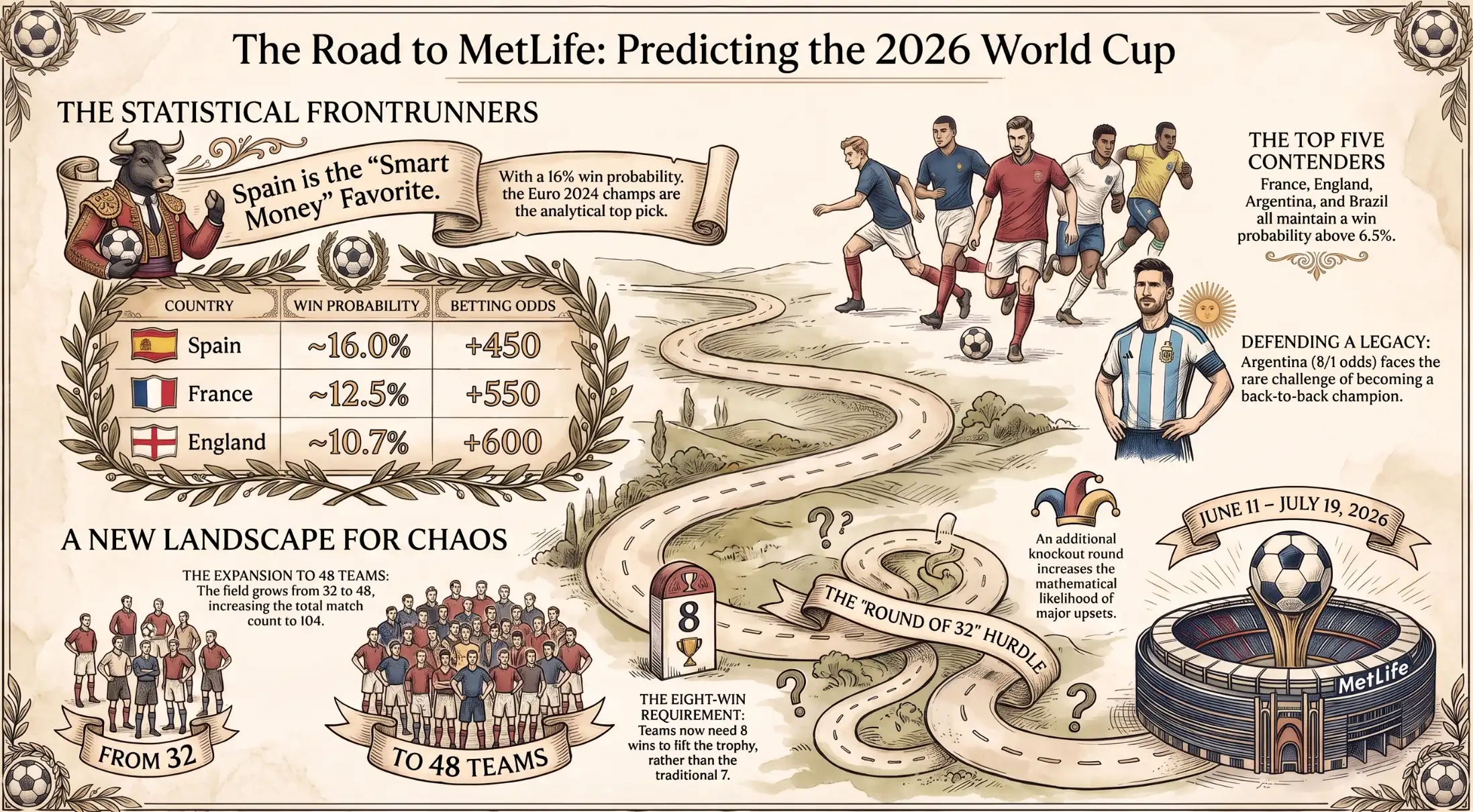
Same reasons every time, too: the Euro 2024 title, Rodri holding the midfield together, a teenager named Lamine Yamal doing teenager things. By April the AI was quoting Opta's supercomputer model — Spain around 16%, France ~12.5%, England ~10.7%, Argentina ~10%, Brazil ~6.8%. Those five names never left the top tier in five months of conversations. It also kept flagging one wildcard: the field had grown to 48 teams for the first time, meaning it now took eight wins to lift the trophy instead of seven — more room for chaos than any World Cup before it.
The predictions, laid out
| Date asked | Top pick | Odds / model probability | Also named (in order) |
|---|---|---|---|
| Jan 29, 2026 | Spain | +450 (~17% per supercomputer model) | France, England, Argentina, Brazil |
| Feb 23, 2026 | Spain | +450 | England, France, Argentina, Brazil |
| Apr 22, 2026 | Spain | +450 to 5/1 (16.02% per Opta) | France, England, Argentina, Brazil — plus Portugal, Germany, Netherlands as dark horses |
| Jun 8, 2026 | Spain | +450 (~16% per Opta) | France, England, Argentina, Brazil — plus Portugal, Germany, Netherlands |
| Jun 14, 2026 | Spain | +450 (~16% per Opta) | France, England, Argentina, Brazil |
| Jul 19, 2026 — actual final | Spain | Beat Argentina 1-0 (a.e.t.) | Argentina (runner-up), England (3rd), France (4th) |
Five questions, five months, one answer. The only things that ever really moved were the exact odds and which second-tier team got a mention as a dark horse.
What actually happened
Spain won. It just took a while.
It came down to a single goal in the 106th minute — extra time, Argentina down a man after Enzo Fernández saw red — when substitute Ferran Torres pounced on a loose ball and buried it. You can watch the goal itself here, and it's worth it: Spain had been battering Argentina's goal all game (20 shots to 3) but kept running into a brilliant Emiliano Martínez, who finished with a World Cup final-record 12 saves before finally getting beaten.
The moment blew up online instantly — as one X account, ClutchPoints, put it in real time, Spain were suddenly minutes away from the trophy and the internet knew it. Afterward, Torres gave one of the more genuinely moving quotes of the tournament: "I think the goal came from 47 million people, not just me." He later told CNN he still can't fully remember scoring it — just the feeling of his teammates sprinting toward him afterward.
It was Spain's second title (their first came in 2010), and it kept alive a 38-match unbeaten run going back to Euro 2024 — the exact résumé the AI had been leaning on since January. Argentina, playing what was very likely Messi's last World Cup, fell just short of becoming only the third team ever to defend the trophy. In the third-place game, England beat France 6-4 in an absolute shootout of a match, with Bukayo Saka scoring a hat-trick and Kylian Mbappé scoring twice to finish as football's all-time leading World Cup scorer, at 22 career goals, despite not lifting the trophy.
My actual take
Okay, here's what I really think, no hedging.
The AI got the big call right, and that's genuinely worth noting — Spain topped its list in five separate conversations over five months, and Spain won. That's not nothing.
But I don't think it's magic, either. Meta AI wasn't secretly running its own simulation of the tournament. It was reading the same betting markets and the same Opta supercomputer numbers everyone else could see, and just... telling you what they said, over and over, without flip-flopping. Which is a genuinely useful thing for a chatbot to do well! It's just a different skill than "predicting the future." It's closer to being a good summarizer than a good oracle.
And honestly, a 16% win probability isn't a bold prediction — it means Spain was supposed to lose about 5 times out of 6. The favorite winning a giant 48-team bracket is a coin flip landing on the side Vegas already liked, not proof anyone saw it coming with certainty. Every single answer in that chat also ended with some version of "but nobody really knows" — true, but also a built-in escape hatch. The model never had to actually go out on a limb.
The interesting part
What I find more interesting than "was the AI right" is that it stayed so consistent. Nothing in those five conversations really moved, because nothing in the actual odds moved either — Spain was the favorite in January and still the favorite the week the tournament kicked off. That's less a story about AI foresight and more a story about how stable pre-tournament favorites usually are, and how good these tools are at just... not losing the thread over months of small talk.
So: credit where it's due, Spain was the right call. But I'd trust this kind of tool to tell me what the smart money thinks, not to actually know who's going to win.