
How to Not Use AI in 2026: A Survival Guide for Engineers Who Still Want to Think

Introduction: The Meat Proxy Problem
In September 2026, a Reddit post on r/ClaudeAI struck a nerve. A senior engineer at a big company described a workplace where every artifact — specs, code, tests, PRDs, tickets, reports — was generated by Claude Code. Nobody read anything. Nobody resolved bugs. Nobody thought. Engineers worked 12–13 hour days "just to press enter." The post garnered 1,533 upvotes and 120+ comments from developers across consulting, startups, academia, and even non-tech fields who felt the same: soul-crushed, disconnected, and reduced to "organic vessels designed to press enter."
This article is not anti-AI. It is pro-human. It is a guide for engineers, managers, and anyone in tech who wants to retain agency, craft, and meaning in a world that increasingly treats code generation as free and human understanding as optional.
The goal is not to reject AI outright — that is neither practical nor desirable for most. The goal is to use AI without becoming a meat proxy, and to know when and how to not use AI to preserve your skills, your sanity, and your soul.
The AI Culture of 2026: What Went Wrong
Before we discuss solutions, we must understand the environment we're operating in. The 2026 AI culture has several defining characteristics that make "not using AI" both difficult and necessary.
1. The "Ship at All Costs" Mentality
Management has internalized the belief that code generation is no longer a bottleneck. Therefore, any slowness must be a human problem. The result: engineers are pushed to ship faster, not better. "Pushing code is not a bottleneck, so why are we slow?" becomes a cudgel. Quality, understanding, and accountability are sacrificed at the altar of velocity.
2. The AI Slop Loop
Work has become a recursive cycle of AI-generated artifacts:
- Product prompts Claude to write a PRD.
- Engineering prompts Claude to write the code.
- QA prompts Claude to write the tests.
- Nobody reads any of it.
A co-worker's AI-generated requirements doc is parsed by your AI, which generates tweaks, which are reviewed by another AI, which passes them back to your AI. Human-to-human communication is dead. The result is a tidal wave of buggy, unmaintainable code — a "slopacalypse" that many predict is imminent.
3. The Accountability Vacuum
AI cannot be held accountable. The labs won't be. So the human remains "in the loop" — not to think, but to absorb blame when things break. As one commenter put it: "You're now just a condom between Claude and your production server." The role is not engineer; it is scapegoat.
4. Loss of Pride and Victory
Shipping something cool used to be an achievement. Colleagues noticed. You felt proud. Now, everyone assumes Claude made it for you, even if you engineered every decision. There is no sense of victory because you didn't do shit — you prompted, pressed enter, and half-ass checked it. As one developer wrote: "I miss those days when I was doing real work and at the end of the day, even if what I did wasn't perfect, I felt a sense of pride and satisfaction because I gave it my best."
5. The Junior Dev Crisis
New engineers are not being mentored. They are handed tickets and told "just use Claude." They learn to prompt, not to engineer. They never develop the deep system knowledge that comes from years of context-building. The bus factor is collapsing. When AI goes down, nobody can do their job.
6. The Consulting Sham
Consultancies have become AI loops: consultants use AI to generate reports for clients who use AI to review them. The only value provided is accountability and plausible deniability — being the external firm the client can blame when things break.
7. The Counter-Narrative: It Doesn't Have to Be This Way
A minority — mostly from startups with healthy cultures — argue that the problem isn't AI, it's bad management. When used responsibly, with a human who understands and is accountable for the output, AI is an amazing tool that lets engineers work at a higher level of abstraction. The key distinction: generation is not completion. If a responsible person can explain the design, defend the tradeoffs, and is accountable when it fails, AI is a tool. If management counts generated output as finished work and makes understanding optional, it has simply stopped paying for engineering.
Best Practices: How to Use AI Without Becoming a Meat Proxy
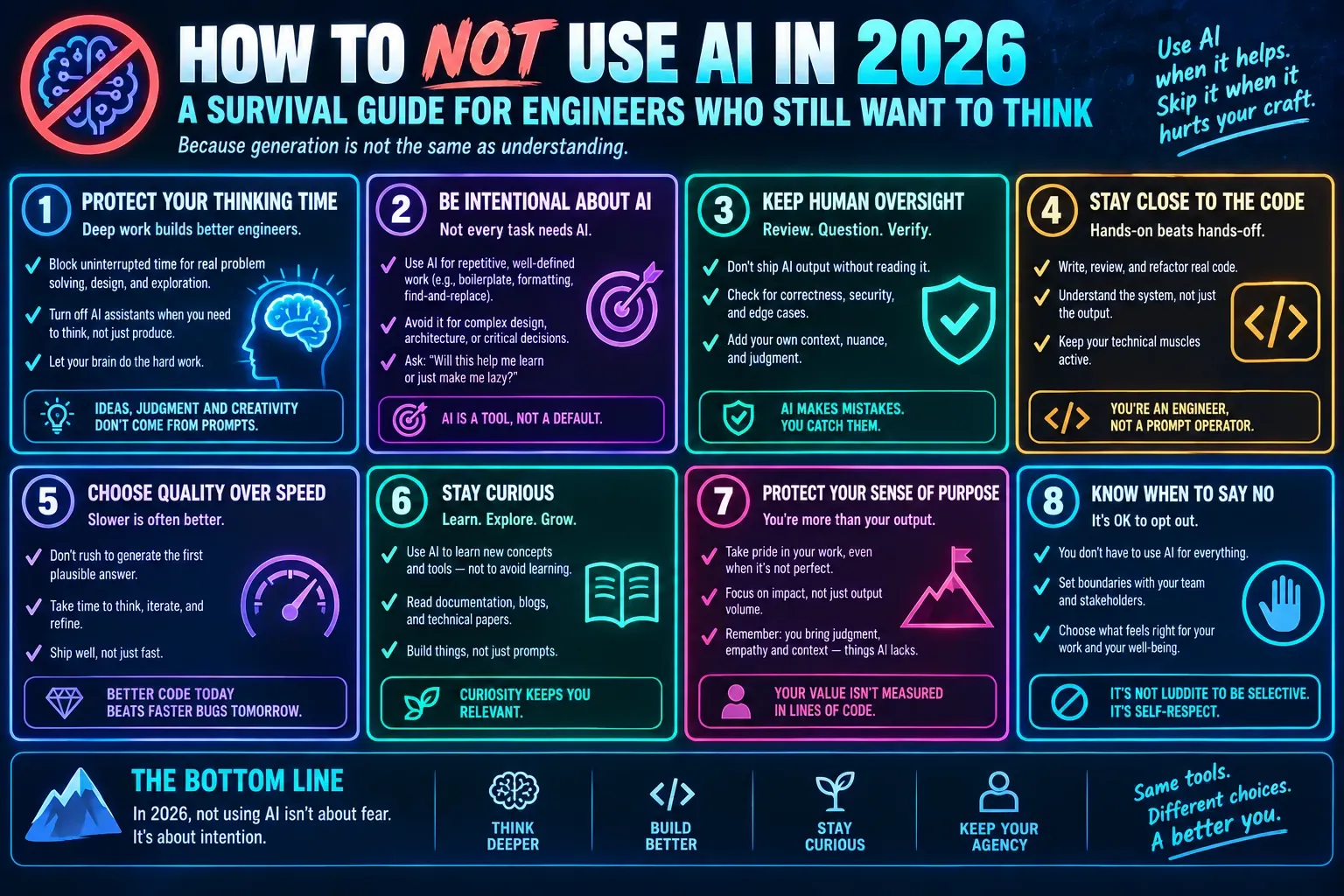
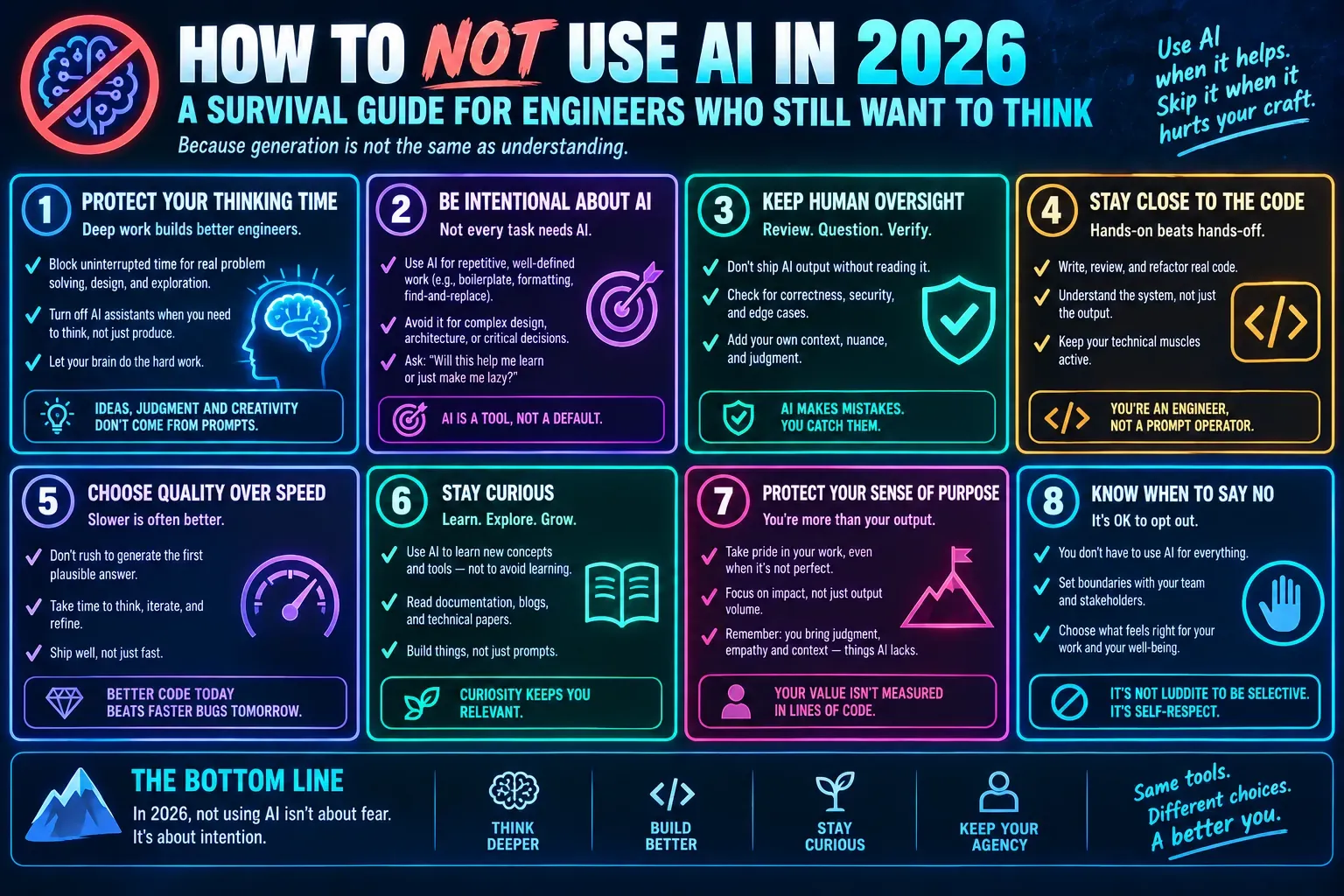
If you must use AI — and in 2026, most of us must — here is how to do it without losing your craft, your agency, and your mind.
1. The Ownership Principle
Every AI-generated artifact must have a responsible human who can explain and defend it.
- Before you prompt, decide: Who owns this? Who will be accountable if it fails?
- If the answer is "nobody," stop. You are about to create tech debt.
- If you are the owner, you must understand the output. If you don't, you haven't finished the work.
2. Generation Is Not Completion
AI output is a draft, not a deliverable. Treat it like a junior engineer's first attempt: useful, but requiring review, correction, and integration.
- Never merge code you haven't read.
- Never ship a spec you haven't understood.
- Never approve a PRD you can't explain to a stakeholder.
3. Read the Code — At Least Once
You don't have to read every line. But you must understand the architecture, the tradeoffs, and the failure modes.
- Ask yourself: If this breaks at 3 AM, can I debug it?
- If the answer is no, either learn it or don't ship it.
- Use AI to explain code you don't understand — but verify its explanation against the actual code.
4. Own the Decisions, Not Just the Prompts
Move up the abstraction layer. Let AI handle boilerplate, but you make the architectural decisions, you define the interfaces, you choose the tradeoffs.
- Write the design doc yourself. Use AI to critique it.
- Define the test strategy yourself. Use AI to generate test cases.
- Choose the database schema yourself. Use AI to optimize queries.
5. Preserve Human Communication
The "AI slop loop" thrives on isolation. Break it.
- Talk to your colleagues. In person. On video. On the phone.
- Write your own emails and messages. AI-generated praise is eerie, not kind.
- When you receive an AI-generated document, ask the author to walk you through it. If they can't, it's not done.
6. Use AI to Learn, Not to Avoid Learning
AI can be a powerful tutor. Use it to understand new concepts, not to skip understanding.
- Ask AI to explain a codebase, then verify by reading key files.
- Ask AI to review your design, then critically evaluate its feedback.
- Ask AI to generate tests, then check that they actually test what matters.
7. Set Boundaries
You are not a machine. You cannot review 10,000 lines of AI-generated code in a day and still think.
- Push back on unrealistic deadlines.
- Negotiate time for review and understanding.
- If management refuses, start looking for a new job. (See "Actionable List" below.)
8. Build Side Projects Without AI
To preserve your craft, you need at least one domain where you are the engineer, not the prompt-presser.
- Write code by hand. Feel the struggle. Enjoy the victory.
- Build something small and complete. Own every decision.
- This is not about productivity. It is about identity and meaning.
What to Avoid: Anti-Patterns of the AI Meat Proxy
1. The "Just Press Enter" Workflow
Avoid: Prompting, waiting, accepting output, moving on. This is not engineering. It is data entry for a machine that doesn't need you.
2. The AI Slop Loop
Avoid: Sending AI-generated documents to colleagues who review them with AI and send back AI-generated feedback. This is theater. It produces nothing of value.
3. "Ship It, Don't Read It"
Avoid: Merging code you haven't read because "it passes tests." Tests are not understanding. Tests are a safety net, not a substitute for thought.
4. The Accountability Dodge
Avoid: Assuming "the AI did it" is an acceptable explanation when something breaks. If you shipped it, you own it. If you can't own it, don't ship it.
5. The Junior Dev Bypass
Avoid: Giving juniors tickets with "just use Claude" as the only guidance. This is not mentorship. It is abandonment. It creates engineers who cannot engineer.
6. The Pride Void
Avoid: Measuring your worth by throughput. Shipping 100 AI-generated features you don't understand is not an achievement. It is a liability.
7. The "AI Is Just a Tool" Cliché
Avoid: Dismissing legitimate concerns about agency, meaning, and craft with "it's just a tool, bro." A hammer doesn't replace the carpenter. An LLM can replace the thinking — and that's different.
8. The Utopian Fantasy
Avoid: Believing that AI will inevitably lead to a post-work utopia where humans relax while machines do everything. History suggests otherwise. Workers must fight for the gains of automation, or the gains will accrue only to those who own the machines.
Actionable List: What to Do Tomorrow
For Individual Contributors
- Audit your current work: Identify every AI-generated artifact you own but don't fully understand. Make a plan to understand or remove it.
- Set a personal rule: Never merge code you haven't read. Never ship a document you can't explain.
- Block time for understanding: Put 1–2 hours on your calendar daily for reading, learning, and deep work. Defend it.
- Write something yourself: Pick one task this week and do it without AI. Feel the difference.
- Talk to a colleague: Have a real conversation about the work, not about prompts. Rebuild human connection.
- Start a side project: Build something small, complete, and entirely your own. No AI. Just you.
- Document your concerns: Keep a private log of instances where AI use has caused problems (bugs, confusion, tech debt). Use it when you negotiate.
For Managers and Leads
- Establish an AI policy: Define where AI use is allowed, where it's encouraged, and where it's forbidden. Publish it.
- Require human ownership: Every AI-generated artifact must have a named human who can explain and defend it.
- Protect review time: Make code review and design review non-negotiable. Do not let "ship at all costs" override quality gates.
- Mentor juniors: Ensure every junior has a human mentor. "Just use Claude" is not mentorship.
- Measure what matters: Stop measuring PRs merged or tickets closed. Measure system reliability, customer outcomes, and team health.
- Watch for burnout: The "meat proxy" workflow is soul-crushing. Check in with your team. Listen.
- Fight for quality: When management pushes for speed at the expense of quality, push back with data. Tech debt compounds. So does burnout.
For Teams
- Adopt a "human in the loop" standard: No AI-generated artifact ships without human review, understanding, and sign-off.
- Rotate "understanding" duties: If AI generates a large change, assign a human to deeply understand and document it.
- Hold AI-free retrospectives: Discuss where AI helped, where it hurt, and what to change.
- Create a "no AI" zone: Reserve some work — architecture, critical systems, security — for human-only engineering.
- Share failure stories: When AI-generated code causes a bug or outage, share the story. Normalize learning from mistakes.
Impact: What Happens If We Don't Fix This
1. The Slopacalypse
If "ship it, don't read it" continues, we will see a massive accumulation of buggy, unmaintainable code. Systems will become fragile, insecure, and impossible to debug. When AI goes down, nobody will be able to fix anything. The result: outages, breaches, and a collapse of trust in software.
2. The Loss of Institutional Knowledge
If nobody reads code, understands systems, or builds context, companies lose bus-factor resilience. When the AI-generated code breaks — and it will — there will be no one who understands it well enough to fix it. The knowledge is not in the humans; it is in the machines, and the machines don't care.
3. The Fulfillment Crisis
The psychological toll of being a "meat proxy" is severe. Loss of pride, agency, and meaning leads to burnout, depression, and attrition. As one commenter put it: "This lack of a sense of victory and accomplishment is really bad psychologically long term, perhaps even worse than the fact our brains are atrophying."
4. The Devaluation of Engineering
If anyone can prompt Claude to generate code, what is an engineer worth? The answer: engineers who understand, decide, and own are worth more than ever. Engineers who only press enter are worth nothing. The profession will bifurcate into a small elite of architects and a large mass of disposable prompt-pressers — unless we push back.
5. The Accountability Crisis
When AI-generated code causes a breach or an outage, who is responsible? The lab? The manager who mandated AI use? The engineer who pressed enter? Nobody knows. This accountability vacuum is a recipe for disaster — legal, ethical, and operational.
6. The Erosion of Craft
Craftsmanship — the pride of building something well — is being replaced by throughput. The result is not just worse software. It is a worse profession. The joy of engineering is being extracted and discarded, like so much AI slop.
7. The Counterfactual: What If We Fix It?
If we establish responsible AI use — with human ownership, review, and accountability — we can have the best of both worlds: AI's speed and scale, and human judgment, craft, and meaning. The minority in the thread who work at healthy startups prove this is possible. It requires management that values quality over quantity and engineers who refuse to be meat proxies.
Conclusion: You Are Not a Condom
The r/ClaudeAI thread ends with a brutal metaphor: "You're now just a condom between Claude and your production server." It is funny, and it is true. But it doesn't have to be.
You are an engineer. You are a thinker. You are a craftsman. You are a human being with agency, judgment, and the capacity for pride. AI can be a tool. It can be a tutor. It can be a collaborator. But it cannot be your master — unless you let it.
The path forward is not to reject AI. It is to use it without becoming it. To own your work. To understand your systems. To talk to your colleagues. To build things yourself, at least sometimes. To demand accountability — from yourself, from your team, from your management.
The "meat proxy" is not a job title. It is a choice. And you can choose differently.
You are not an organic vessel designed to press enter. You are an engineer. Act like it.