
$1.9 Million, Nine Restarts, and Zero Hiding: Xiaomi's MiMo V2.6 Live Dashboard

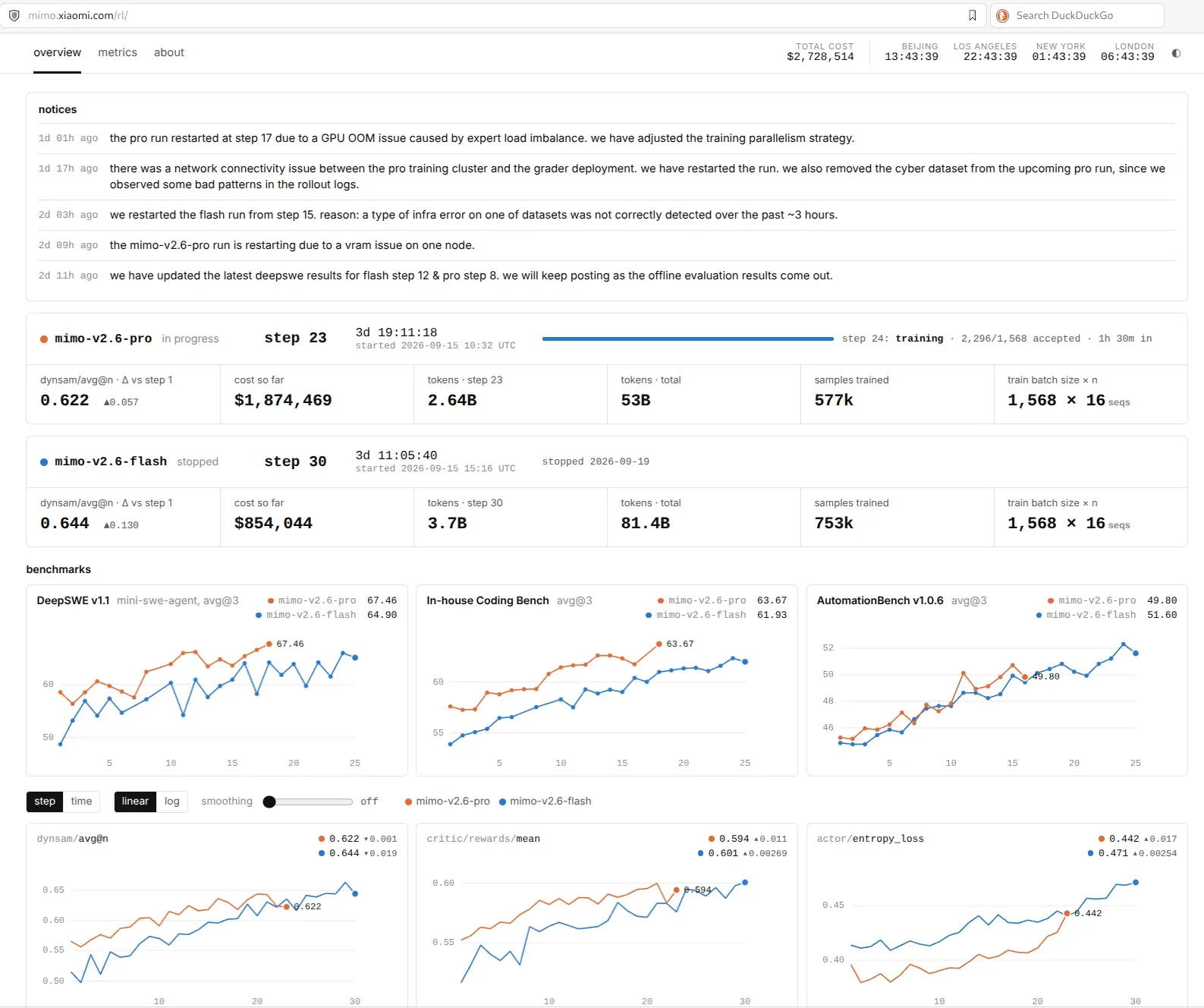
Xiaomi did something this week that no frontier lab has attempted: it streamed its reinforcement learning run to the public.
The MiMo team, led by former DeepSeek researcher Luo Fuli, launched a live dashboard on September 16 showing real-time training metrics for two unreleased models: MiMo-V2.6-Pro and MiMo-V2.6-Flash. The page pulls directly from training logs, displaying reward curves, token consumption, benchmark scores, and running costs. It also shows the embarrassing parts—restarts, GPU out-of-memory errors, and dataset issues.
The Setup
The training run scales across three dimensions, according to Luo Fuli:
- Compute: Each step processes roughly 2 billion tokens, using 1,568 prompts with 16 rollouts per prompt, fully asynchronous
- Environments: Multi-task agentic RL, mixing code, visual, general, and chat datasets in a single run
- Grading: Agentic in-group credit assignment with test-case and rubric-based rewards
That works out to about 25,088 attempt trajectories per training batch. The average context length hovers around 100,000 tokens, with episodes running 57–65 turns.
The Dashboard Itself
The live page shows a dynamic sampler with 25+ datasets feeding into each step. Code datasets dominate, making up roughly two-thirds of the training mix, with visual and general tasks splitting most of the remainder.
What’s notable is what the dashboard doesn’t hide. The notices panel logs every restart with timestamps and explanations:
- “GPU OOM issue caused by expert load imbalance”
- “Network connectivity issue between the pro training cluster and the grader deployment”
- “A type of infra error on one of datasets was not correctly detected”
As of the latest available data, the Pro run had restarted nine times. Most labs would bury this. Xiaomi put it on a public webpage.
Benchmarks
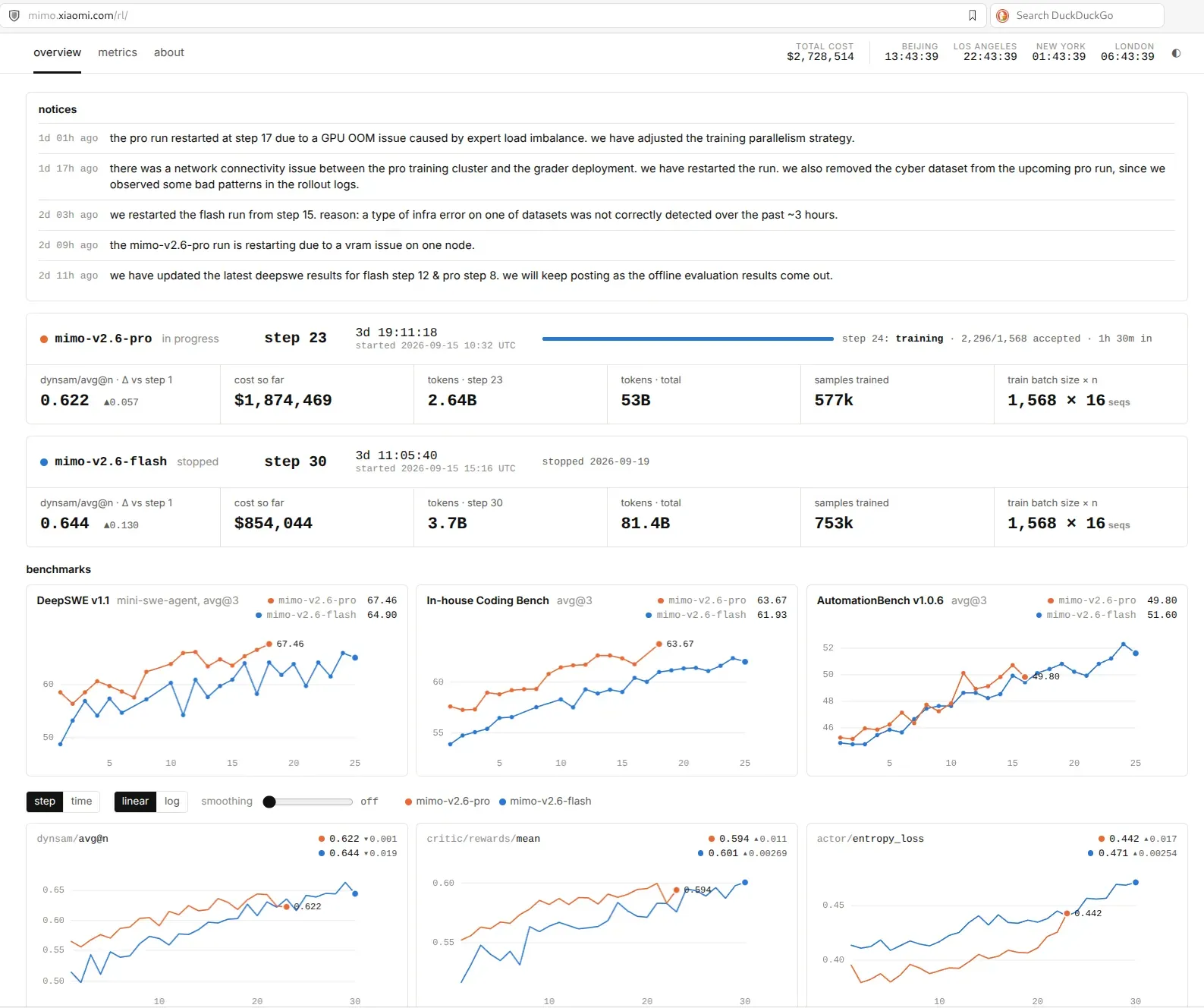
| Benchmark | MiMo-V2.6-Pro | MiMo-V2.6-Flash |
|---|---|---|
| DeepSWE v1.1 | 67.46 | 64.90 |
| In-house Coding Bench | 63.67 | 61.93 |
| AutomationBench v1.0.6 | 49.80 | 51.60 |
These are mid-training numbers, not final. For context, the previous MiMo-V2.5 scored 19% on DeepSWE, making this a substantial jump. The Pro model now sits in a competitive tier, trailing GPT-6 Astra (74%) and Claude Fable 5 (70%) but ahead of where most open models land.
The Cost
The dashboard publishes the bill. At peak observation, the two runs were consuming approximately $30,900 per hour combined. The Pro run alone was burning roughly $2,060 per hour; Flash about half that.
By September 18, cumulative spending had reached $1.92 million. For a model that hasn’t been released yet.
What Users Are Saying
The transparency play has generated genuine enthusiasm in developer communities—and no small amount of skepticism.
The Positive
On the openness itself:
"This is crazy, but sadly Anthropic/OpenAI will never do this. What has happened to this world, where Chinese companies are more open than US or even EU companies?"
— Hacker News
"Sometimes you're confident about what you're doing and show how you work to the world."
— Hacker News
On real-world performance:
"The cost is unbelievably low, and the quality of intelligence I get is equivalent to when I was working mostly with Anthropic models. When I add the cost of M-token in the ROI math—Jeez! MiMo is an order of magnitude better."
— Developer using MiMo in production
"Those MiMo models are really good at tool calling and following instructions."
— Hacker News
The Negative
On the livestream as marketing:
"感觉是炼不出来,所以直播搞搞噱头这样的"
Translation: "Feels like they couldn't finish training, so they're doing a livestream for hype."
— Chinese developer forum
On the previous version's quality:
"2.5pro拉胯死了, 买的官网… 一堆bug多如牛毛, 写node各种语法错误"
Translation: "2.5 Pro was absolutely terrible. Bought from the official site… a ton of bugs everywhere, writing Node with all kinds of syntax errors."
— Chinese developer forum
"内测用户表示,那点余额一毛都想要退款了。如果开源没话说,闭源模型这样子,啥也不是"
Translation: "As a beta tester, I want a refund down to the last cent of my balance. If it were open source, fine. But a closed-source model like this? It's nothing."
— Chinese developer forum
On technical concerns:
"Risk of benchmaxxing—using benchmarks as stopping criteria during training could lead to overfitting."
— Hacker News
"Claude Distill Requests: hidden" — noted on the dashboard. Despite the open training narrative, the model may still rely on distillation from external proprietary models.
— Hacker News
Dashboard numbers may reset or replay upon page refresh, raising questions about the authenticity of the "real-time" data.
— Hacker News
What This Means
The transparency play is unusual. Western labs typically announce models after training completes, with polished benchmark tables and no mention of the eleventh restart. Xiaomi is doing the opposite: showing the messy middle.
Luo Fuli framed it simply: the team spent six months asking "how far can RL scale?" The dashboard is their answer in progress.
Whether this becomes a trend or remains a Xiaomi-specific stunt is unclear. But for anyone curious what frontier RL training actually looks like—the costs, the failures, the slow climb of reward curves—the page is live and updated continuously.
The MiMo-V2.6 series is listed as "coming soon." No release date, pricing, or API details have been announced.